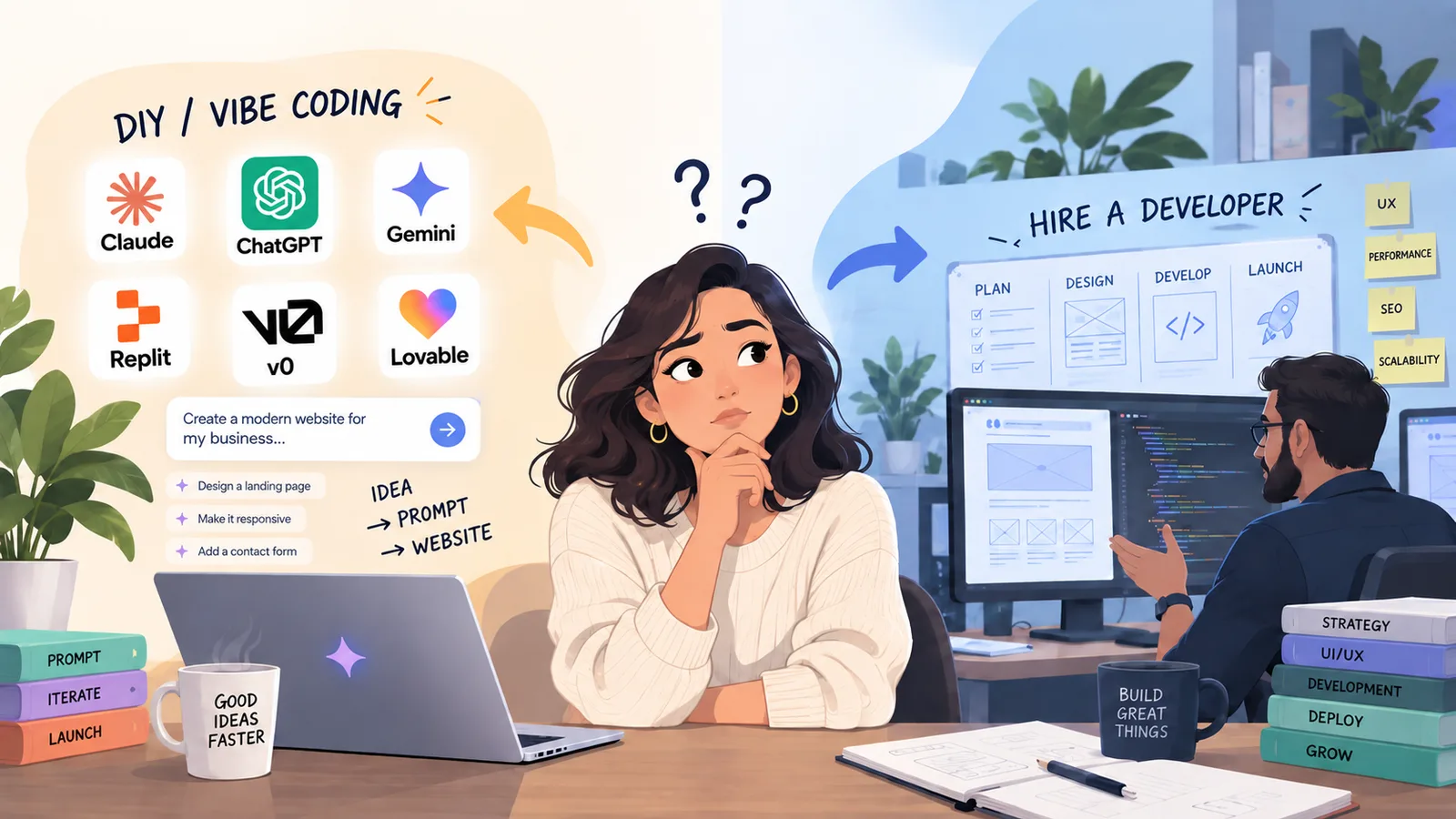
Can ChatGPT build a website? Yes. The question is whether you understand what it built.
Vibe coding your own site is genuinely the right call for some businesses. Here is the line where it stops being one, and it arrives earlier than most people expect.
John "Holliday" Mahlow
Founder, Cursive Media
- Read time
- 13 min read
- Updated
Yes. ChatGPT can produce the code for a real, working website, and in 2026 it can do it from a plain-English prompt in a single sitting, better than most people expect. We build websites and web apps for a living and we use AI in our own work every day, so we’re not going to pretend otherwise.
This also isn’t the post where a web agency tells you AI sites are toys and you should back away slowly toward our pricing page. For a personal site, a resume, a one-pager, or an idea you want in front of people this week, I’d genuinely tell you to build it yourself before paying someone like us.
The problem isn’t that AI builds a bad website. It’s that it builds a convincing one. You get something that looks finished, you didn’t pay anyone, and a reasonable conclusion follows: maybe that’s all there was to it. That’s the part worth talking about, and almost nobody does.
What “vibe coding” actually means
The term came from developer Andrej Karpathy, and IBM’s definition is worth reading closely because the important word is hiding in it: vibe coding is "the notion building products with nothing but AI tools and natural language prompts." IBM then separates it from what it calls agentic coding or agentic engineering, which involve "more deliberate use of AI coding tools by an experienced programmer."
Read that twice. Vibe coding isn’t defined by using AI. It’s defined by the absence of someone who knows what the AI just did. That distinction is the whole argument of this post, and it means nothing here is an argument against AI. Professionals are using the same tools, on the same day, to build the same things.
Getting it to work is not the same as understanding how it works
You tell the AI what you want. It writes something. You test it. It works. That’s a genuine result and you should feel good about it.
But why does it work? Where does the data go? What else does that piece depend on? What happens when the service on the other end is down, or somebody submits something strange, or you come back in six months and ask for one change?
You know that it works. That’s a different thing from knowing why it works, and the gap between those two only shows up on the day something stops.
You might be fixing something or creating something, but you don’t really understand how something works, or why, or why it broke.
The sites I’d tell you to build yourself
No hedging on this, and no manufactured fear. There are websites where hiring a development company is a waste of your money.
- A personal site or portfolio. Build it yourself.
- A CV or resume online. Build it yourself.
- An about-me page, or a single page explaining who you are and what you do.
- An idea you want to validate before spending real money. Speed beats polish here. Generate it, put it in front of people, find out if anyone cares.
- The budget is genuinely zero. A decent AI-generated page beats no website every single time, and nothing here should talk you out of shipping one.
A basic business site can sit in that list too. But the moment it does, there’s one question I’d ask before agreeing: what happens when somebody actually contacts you?
How to get a genuinely good result if you try it yourself
If you’re taking a run at this, and for plenty of businesses you should, the difference between a generic AI page and a good one is almost entirely in how you ask. A few things we do daily that work just as well in a chat window:
- Feed it your real business, not your category. “A website for a plumber” gets you the median plumber site on the internet. Paste in what you actually do, who calls you, your service area, your real reviews, and how you’re different from the two competitors you lose jobs to. Specific input is the whole game.
- Tell it the one job of the page. “Make this page get visitors to call about water heater replacement” produces a much better page than “make me a nice website.” Every section should earn its place against that job.
- Build one page first. A five-page site generated in one shot is five mediocre pages. One page, iterated until it’s right, beats all of them.
- Iterate in small, named steps. “Make the headline speak to homeowners with a leak right now,” “move the phone number above the fold,” “cut this section in half.” Ten small rounds beats one giant prompt.
- Make it critique itself. Ask “what would a conversion expert change about this page?” before you ask for changes. The model is a genuinely good critic of its own first draft.
- Ask for the unglamorous parts. Meta title and description, descriptive alt text on every image, one h1 and a sane heading order. ChatGPT does these well, but only if you ask.
Do that and you’ll have a page you’re not embarrassed by. Genuinely. Now for the part under the waterline.
A contact form is where I start asking questions
Most advice puts the DIY line at something dramatic: payments, logins, user accounts. I put it much earlier, and much more boringly: the line is anything that has to communicate with a third party. A form counts. Payments and integrations are the same beast, just louder.
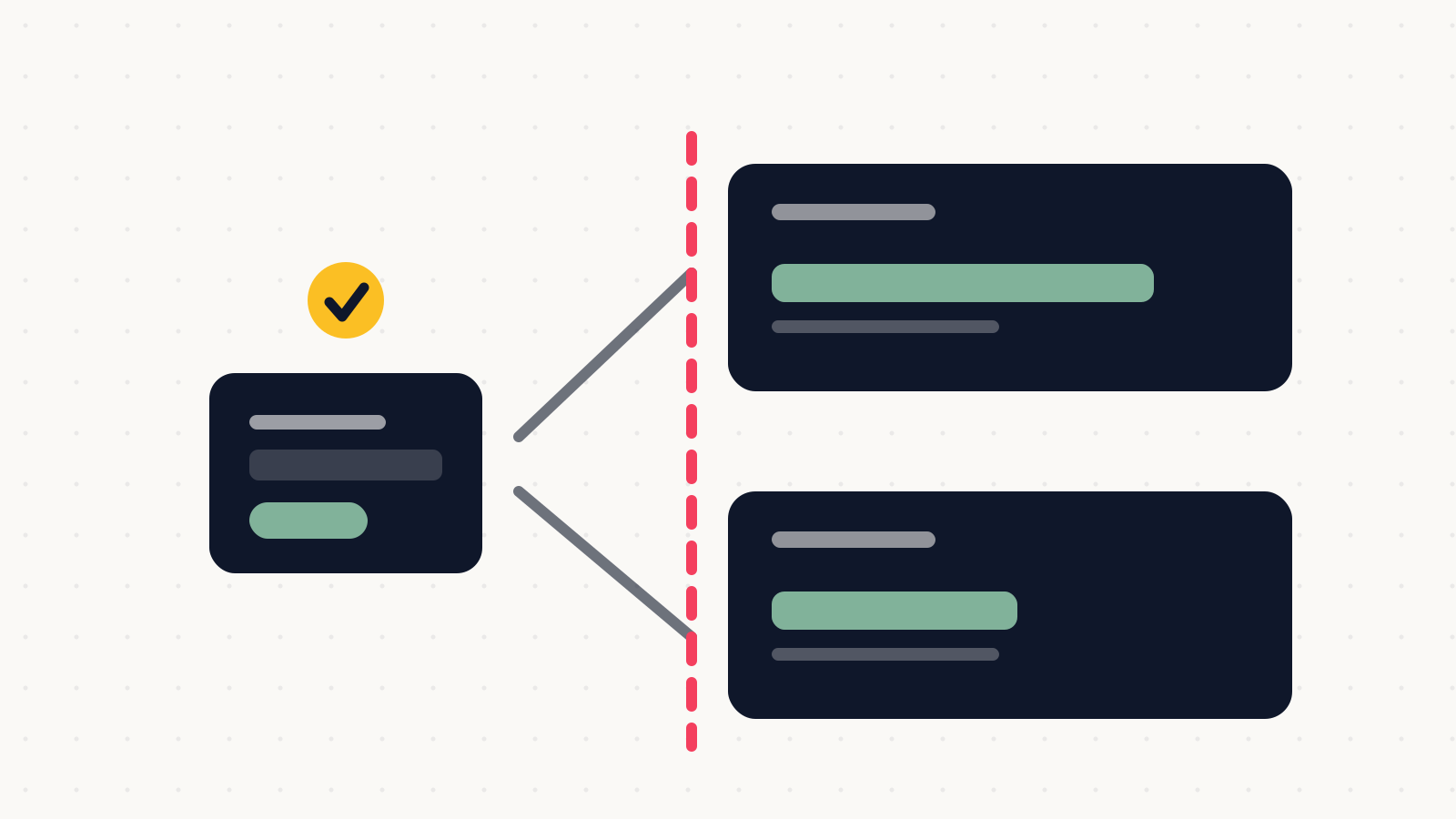
A visitor types their name, phone, email and a message, and clicks a button. That looks like the simplest thing on the internet. So: where did that lead go? Did anyone receive it? Was it stored, or does it live in one email somebody can delete? Did it reach your CRM, with the right source attached so you know which ad or page produced it? Did an automation fire? Did the customer get a confirmation? What happens if the CRM is down for ten minutes? Does the lead queue, or evaporate? What happens when the same person submits twice? And the one that actually gets people: how would you know, three months from now, that it quietly stopped working?
A form that swallows leads looks exactly like a form that works. That’s the whole problem. Nothing turns red. You just get fewer calls and never find out why.
This is why I get cautious when someone says they only need a “simple website.” Sometimes they do. Sometimes what they actually need is the front door of a lead system, and nobody has said that out loud yet.
You can fix your own car from a YouTube video too
I want to be careful here, because none of this is a claim that people can’t do it. They can. It’s like anything else. You watch a video about fixing a car or doing plumbing work, you follow it, and you can absolutely build a website.
The trouble isn’t the instructions. It’s that following them successfully doesn’t teach you the system around them. The video solved one specific problem. It didn’t explain what else that part touches, or what it means when the symptom comes back different next month.
Connecting a form to a CRM, taking payments, syncing appointments, calling an API, triggering an automation. All of it might only take a few prompts. The code appearing on your screen was never the valuable part. Understanding how those pieces behave together is.
The real test is the day something breaks
The happy path is easy. Customer fills out the form, contact appears in the CRM, text goes out, appointment gets booked, everyone’s pleased. Nobody needs a professional for the happy path.
Then one day a lead doesn’t arrive. Now: is it the website, the form, validation, authentication, an API, the CRM, the workflow, the data being passed between them, the third-party service, or a change somebody made last Tuesday? If you understand the system, you start eliminating possibilities. If you don’t, you’re describing symptoms to an AI and hoping.
And there are two costs in that, not one. The first is the time you spend not knowing. The second is quieter and worse: while the AI fixes the thing you reported, you’re hoping it doesn’t break something that was working fine. That’s the part you never see in the five-minute demo where someone builds an app from a prompt.
None of which is an argument against using AI to fix it. We do. The difference is judgment about what to accept, what to reject, what to test, and when the answer on screen doesn’t make sense.
An engineer with no stake in this says the same thing
In September 2026 Mitchell Hashimoto, who founded HashiCorp and has rather more credibility on this than a Houston web shop, posted what he calls his "whiteboard defense," and described it as his benchmark for responsible AI usage:
I should be able to pull you aside at any moment and ask you to explain any customer-facing system you’ve shipped. You should be able to clearly explain how it works and defend the decisions you made.
He’s explicit that this isn’t about memorizing code: "I don’t expect line-level familiarity with the code." The test is whether you can answer why you did X instead of Y, what happens if someone behaves maliciously, and where this fails.
And here’s the part I’d underline, because it’s the same concession I made earlier in this article. For proofs of concept, demos and experiments, his position is: "Generate 100% of it and understand none of it. Speed over quality every time in those specific scenarios." Then: "if you’re shipping customer-facing work, you can’t be shipping things you don’t understand at a high level."
That’s the line, drawn by someone with no interest in selling you a website. Build your experiment however you like. The standard changes when a customer is on the other end. You don’t need to become a programmer. But somebody should be able to answer “where does this fail?”
What AI generates in minutes vs. what someone still has to do
| AI generates in minutes | Someone still has to do |
|---|---|
| A complete, decent-looking page | Put it on a domain with hosting, DNS, and SSL, then keep all three healthy |
| A contact form’s markup | Wire the form to something real: delivery, storage, spam filtering, and an alert a human actually sees |
| Meta titles and descriptions | Site architecture, page speed, local signals, and the months of consistent work rankings actually take |
| Copy for every section | Copy checked against what your customers actually say, search, and object to |
| Code that works today | Updates, security patches, and the fix when something breaks at 9pm on a Friday |
| A page | A system that turns visits into booked jobs |
Hosting, domains, DNS and SSL are the unglamorous version of this. Your domain has to point at your host, the www and bare versions have to agree, and the certificate has to renew without anyone remembering it exists. Easy when you’ve done it forty times, genuinely maddening the first, because every mistake looks identical from outside: the site is just down.
Then there’s follow-up. A lead answered in five minutes and a lead answered tomorrow are different businesses. New inquiries should land somewhere and trigger an instant reply, with a sequence for everyone who doesn’t respond. That wiring is in 10 things every local business should be automating. No generated page includes any of it, because none of it lives on the page.
And accessibility, which generated markup routinely gets wrong: low-contrast text, unlabeled inputs, missing alt text, pages a keyboard can’t navigate. That turns away real customers, and it’s legal exposure.
AI can build a website. It still struggles to build yours.
The technical side is only half of it. There’s also the actual person visiting. What are they looking for? What do they already know? What are they confused about? What should they see first, and do next? What language sounds like your company and not a category? Which call to action actually matters?
AI will generate an answer to all of those. That doesn’t make the answer good. It doesn’t think design. It repeats what it has seen and been trained on. Which is exactly what you’d expect: if thousands of people ask similar models for a “modern professional website,” nobody should be surprised when the results converge.
I can usually look at a site for a few seconds now and suspect nobody edited what the AI produced. A headline that could belong to any company in any industry. The same point restated in three different sections. Every section carrying its own call to action, so three or four buttons compete above the fold. A testimonial that could have come from anyone. A stock photo that has nothing to do with the business. Copy that reads polished but sounds like nobody in particular.
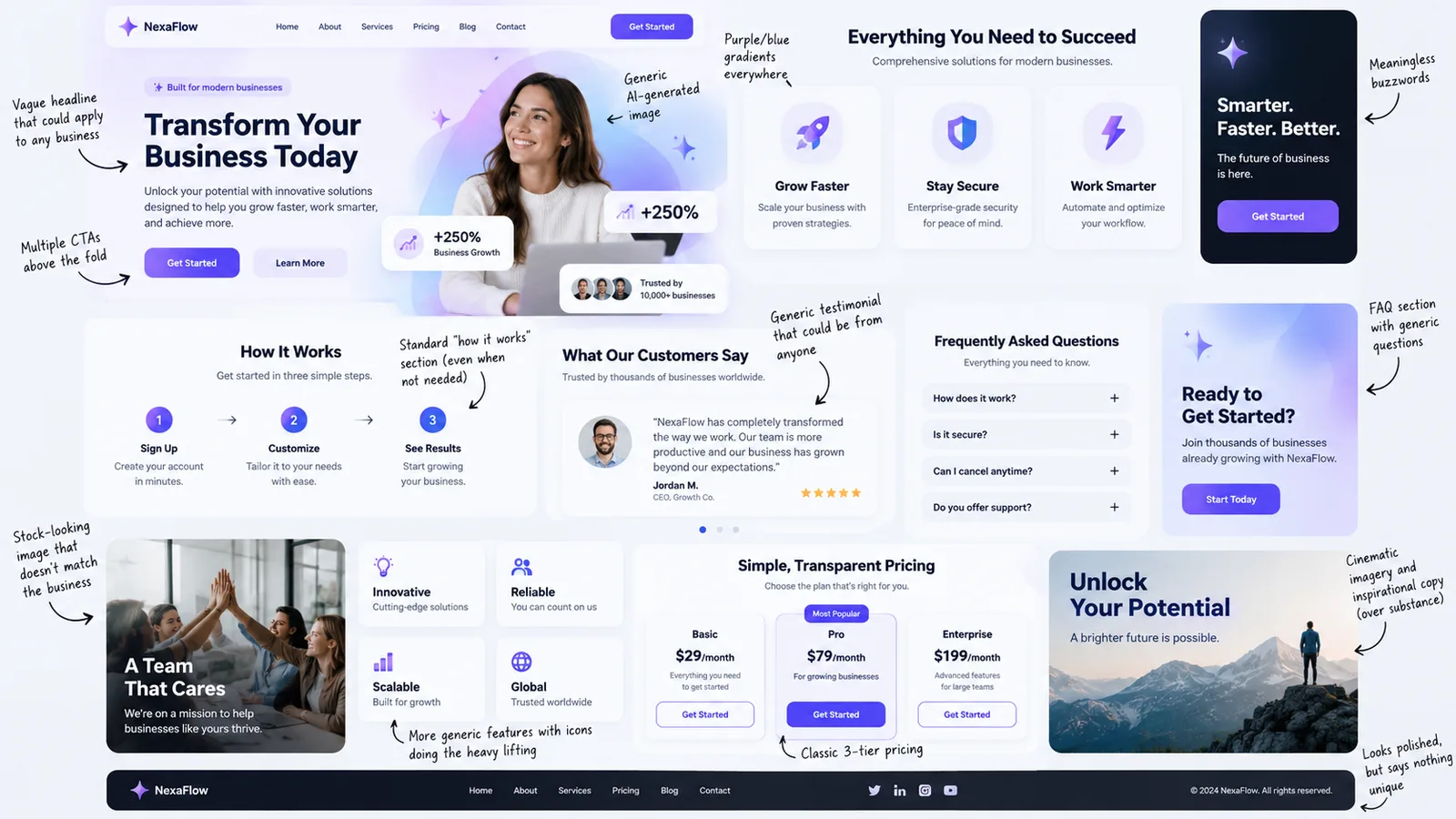
Individually, none of those are mistakes. A pricing table is fine. An FAQ is fine. The problem is the sum: a page assembled entirely from things that work in general, and nothing chosen because it was true of this business in particular.
To be fair: none of that proves AI was involved, and I’m not claiming I can prove it. What I’m saying is that unedited AI output is developing a recognizable look, and your business probably doesn’t want to be recognizable that way. It means somebody needed to edit it, not that it shouldn’t have been generated.
What happened when someone brought us one
A client came to us with a site built by an AI builder. Visually, it looked like a website. Underneath, the contact form was effectively a mailto link. There was no real backend. The site advertised access to a customer portal that had never been built. It wasn’t indexed. There was repeated copy and duplicated imagery. It couldn’t easily be moved or extended, and when it broke nobody could fix it.
I’m not going to pretend that’s every AI-built site, because it isn’t. This is one job, and I couldn’t tell you which tool produced it. But it’s a clean illustration of the thing I keep circling. Somebody looking at that homepage would reasonably conclude the project was much further along than it was. The visual layer was convincing enough to hide how much underneath still hadn’t been figured out.
Why we usually start with cleanup and sometimes end up rebuilding
If you bring us something you built yourself, I’m not going to tell you it’s garbage. Usually we start by looking at what’s there. Sometimes it needs a cleanup. Sometimes chunks of it are perfectly good.
But fairly often, once we’re deeper in, I end up recommending more of a rebuild than the owner expected. You should absolutely question that, because we’re a web development company and a rebuild is the more expensive recommendation. Ask me to justify it. That’s a reasonable thing to ask.
The honest reason is that the problem usually isn’t one broken component. It’s that the site got made one prompt at a time, and nobody ever stepped back to decide what it’s for, how a customer should move through it, how it connects to the rest of the business, what the brand should sound like, or what should happen after somebody converts. Past a certain point, correcting every individual decision is more work than making the right ones once.
So what are you actually paying for?
Not typing speed. AI is very good at producing code, and we use it throughout our own builds to kill the repetitive parts and move faster. Pretending otherwise would be strange.
You’re paying for expertise, experience and professionalism. Then, concretely: understanding the brand, setting up workflows so they behave correctly, connecting forms so leads actually arrive, and understanding the human experience of the person on the other side of the screen. That last one is the part AI can’t do yet, and it’s the part that decides whether a site works.
Underneath all of it is accountability. Somebody knows what questions to ask before anything gets built, knows what to test, knows when the AI’s answer doesn’t make sense, and owns the result instead of saying “well, that’s what it generated.” That’s web and app development that ends in a working system: hosted, monitored, wired into your CRM, following up on every lead. We use AI throughout that build and in the business afterward, running chat that answers after hours and follow-up that never forgets.
The code got cheaper. The judgment didn’t.
When to keep going, and when to get another set of eyes
Keep building it yourself when the site is mostly informational, when it’s a personal project or an experiment, when nobody depends on it to run the business, when there are few or no outside integrations, when rebuilding it later wouldn’t hurt, and when you’re comfortable troubleshooting it. That’s exactly where these tools shine. Use them.
Start thinking about help when customer information moves through it, when forms need to reach another system reliably, when payments or booking are involved, when APIs or automations depend on it, when several systems have to stay in sync, when a lost lead is a real cost, when downtime matters, when you’re spending more time troubleshooting the site than running the company, or when standing out from competitors matters more than simply being online.
There’s no point at which you’re forbidden from doing it yourself. It’s a risk decision, and it scales with how much your business leans on the thing.
The question isn’t “can AI build my website?”
It can. That question gets less interesting every month. The better one is: who understands what we built?
Who knows why it works, what’s connected to what, what happens after a customer hits submit, how to diagnose it when it breaks, and why the page is laid out this way rather than another way?
If the answer is you, keep building. Genuinely. If the answer is nobody, because the AI made all of those decisions and none of them were ever reviewed, that’s the moment to get another set of eyes on it.
So try it. Generate a page with the prompting tips above and see how far you get. If you hit the point where the page has to become a system, book a strategy call. We’ll tell you honestly whether you even need us. Sometimes the right answer really is the page you already made.
John "Holliday" Mahlow
Founder, Cursive Media